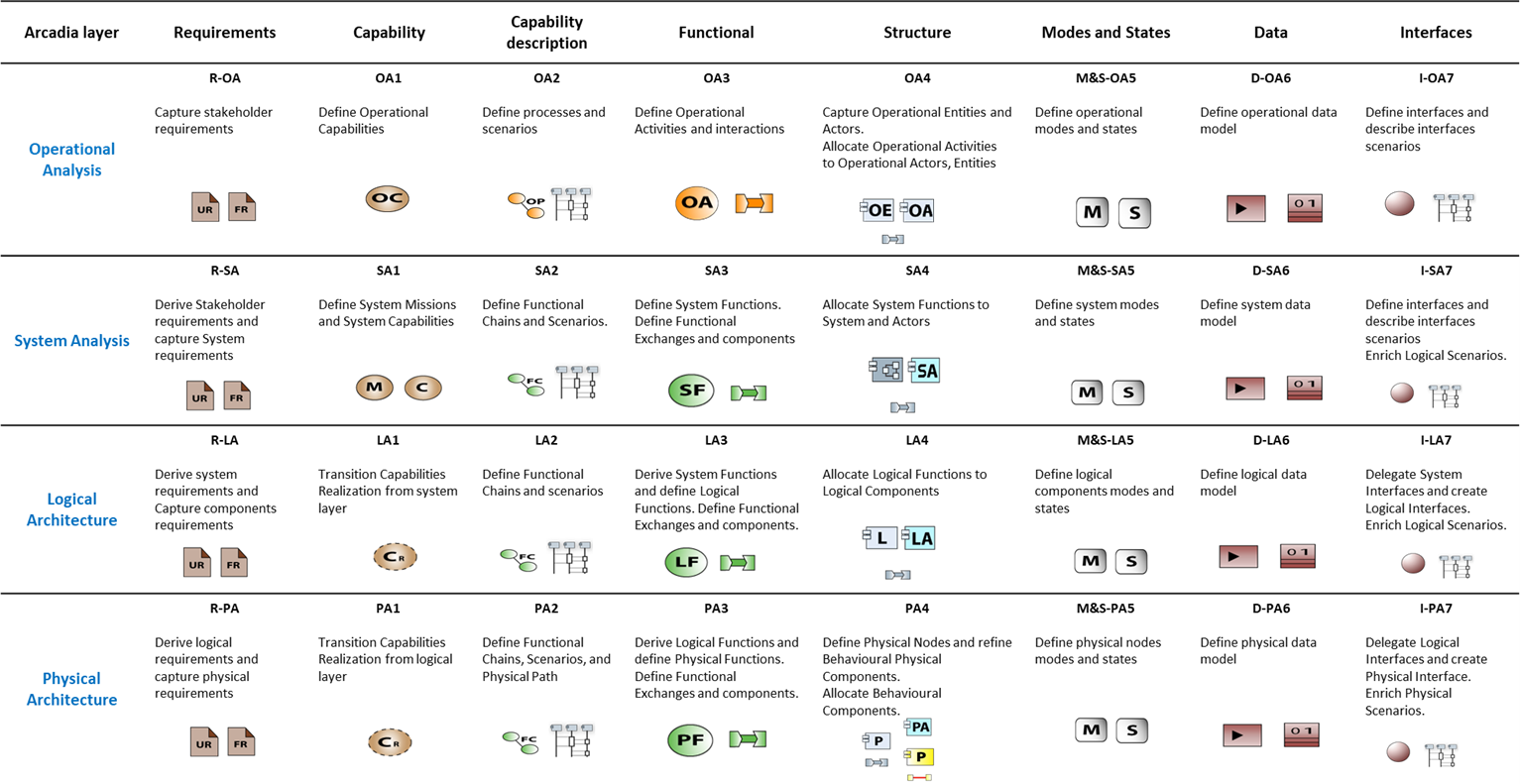
Arcadia is a tooled method devoted to systems & architecture engineering, supported by Capella modelling tool.
It describes the detailed reasoning to
It can be applied to complex systems, equipment, software or hardware architecture definition, especially those dealing with strong constraints to be reconciled (cost, performance, safety, security, reuse, consumption, weight…).
It is intended to be used by most stakeholders in system/product/software or hardware definition and IVVQ as their common engineering reference and collaboration support.
Arcadia stands for ARChitecture Analysis and Design Integrated Approach.
A series of online documents to dive into the principles and concepts of Arcadia:
Arcadia is a system engineering method based on the use of models, with a focus on the collaborative definition, evaluation and exploitation of its architecture.
This book describes the fundamentals of the method and its contribution to engineering issues such as requirements management, product line, system supervision, and integration, verification and validation (IVV). It provides a reference for the modeling language defined by Arcadia.
Jean-Luc Voirin, leader of the creation of the Arcadia method, along with some of the leaders on developing and deploying MBSE Arcadia & Capella practices in Thales. From right to left: Pierre Nowodzienski, Jean-Luc Voirin, Juan Navas, Stephane Bonnet, Frederic Maraux, Gerald Garcia, Philippe Fournies, Eric Lepicier.
Architecture as prime engineering driver
Arcadia, a model-based engineering method
Noticeable features of Arcadia
Definition of the Problem - Customer Operational Need Analysis
Formalization of system requirements - System Need Analysis
Development of System Architectural Design - Logical Architecture (Notional Solution)
Development of System Architecture - Physical Architecture
Formalize Components Requirements - Contracts for Development and IVVQ
Co-Engineering, Sub-Contracting and Multi-Level Engineering
Adaptation of Arcadia to Dedicated Domains, Contexts, Etc.
Equivalences and Differences between SysML and Arcadia/Capella
Crucially, this wave has democratised storytelling. Women filmmakers like Aparna Sen and Anjali Menon have gained prominence, and actors like Fahadh Faasil and Parvathy Thiruvothu have become icons of a new, psychologically complex performance style. Malayalam cinema has once again become what it was always meant to be: a restless, intelligent, and uncompromising mirror to Malayali culture. Streaming platforms (Netflix, Amazon Prime, Hotstar) have amplified this reach, making a small regional industry a global critical phenomenon.
: Directors like Padmarajan and Bharathan made films that were neither "art house" nor "masala," but deeply human. 🌊 The New Wave: Post-2010 hot mallu aunty seducing young boy video target hot
Malayalam cinema has had a profound impact on Indian culture, influencing the way stories are told and films are made. The industry's focus on realistic storytelling, socially relevant themes, and nuanced characterizations has raised the bar for Indian cinema as a whole. Crucially, this wave has democratised storytelling
Take Premam (2015). On the surface, it is a romantic comedy. But culturally, it celebrated the new Kerala: one where religion is casual, where a Christian heroine can marry a Hindu hero without melodrama, and where a chayakada owner is the moral center of the universe. It was a revolutionary act of normalizing Kerala’s syncretic culture. he is often a flawed
The hero in Malayalam cinema is rarely a savior; he is often a flawed, vulnerable common man.